 |
WELCOME TO Naval Career |
|
|
WELCOME TO Naval Career |
|
The
page is dedicated to the folks I met along the way...
As a sailor, most of my time was spent ashore because of my rating as Mineman (MN)
This is an outline of my naval career:
I went to Boot Camp in Bainbridge, Maryland, October, 1955 and graduated, December, 1955, with a service company.
Boot camp wasn't as difficult as I had expected. We missed mess hall duty and got to harass the incoming recruits. I guess Bainbridge is now a shopping mall, or something.
I was approved for Class 'A' School, Mine Warfare, Yorktown, VA. and graduated in 1956 in class 15-56.
Yorktown was a wonderfully historic site but that was about it. Nick's Seafood Restaurant was the place most sailors hung out. Liberty was in Newport News or Norfolk and was a long hitch-hike away.
I was accepted for service as a Mineman Seaman (MNSN) at HDU (Harbor Defense Unit), Little Creek, VA.
Tidewater, Virginia was great and I really enjoyed it--especially the proximity to the beach.
My service there was on small craft. First, there was an obscure 52-foot harbor work boat-L-81. We left at 6:00 AM from the dock at Harbor Defense Unit (HDU) at Little Creek, bound to Cape Henry, next to Virginia Beach. There, we assisted in retrieving existing cable in order to attach additional mines on the string. The mines were carried by the illustrious USS YMP-2. These mines were planted across the harbor and were designed to sink any enemy ship or submarine foolish enough to try and penetrate the entrance to Hampton Roads. At Little Creek, I worked aboard the USS YMP-2, a harbor mine planter that was hands down, the ugliest naval craft ever built.
With the work boat, we would plant these humongous, one-ton Mark 18 mines all the way across where the Chesapeake Bay Bridge/Tunnel is today. The work was at least three miles off-shore so "Ship's Stores" stowed wax paper-wrapped cartons of cigarettes (Pall Malls and Camels) aboard for sale at 90 cents a carton, as soon as we passed the three-mile limit. Not a lot of choice but certainly a bargain.
I got a lucky transfer to at HECP (Harbor Entrance Control Post), Fort Story, VA.
Our sister station was on the tip of Cape Henry, where the nation's first lighthouse was built. They needed jeep driver and someone to man the observation posts and I raised my hand first. The mines we planted from HDU could be exploded from Harbor Entrance Control Post (HECP) at Ft. Story, Va. When I arrived, I immediately tossed my seabag on an overhead bunk and fetched my bathing suit for a dip in Virginia Beach, 100 yards away from the barracks.
I sometimes hitched a ride off-shore with the Army guys aboard Weasels, Alligators and DUKWs while they were training in the breakers. ' Tough duty, I'll tell 'ya, somebody had to do it!
My two-year stateside hitch was up and I accepted an available position in Yokosuka, Japan as Mine Warfare Technician (MNSN). My other choice of duty was aboard the USS Intrepid (CV-11) maintaining "unconventional weapons." I didn't like the sound of that.
I flew a "Super Connie" from Norfolk to San Francisco and was bussed to the pier at Treasure Island for passage on the USNS General C.G. Morton (T-AP138), outbound for Yokohama, Japan.
President Eisenhower had just sent National Guard troops to Little Rock, Arkansas to enforce school integration. It was a particularly warm autumn. I had just left my sweetheart in Newport News.
I will always remember the beautiful sunset as we passed beneath the Golden Gate Bridge. The sea was calm and we settled back on five-tier bunks for the voyage.
After two weeks, I could smell the island of Honshu. It smelled like fertile soil with perhaps a measure of fertilizer. If you've been there, you know what I mean. We tied up 36 hours later. I will always remember the dock crew. They all were wearing getas--what we call 'flip-flops.' We rapidly disembarked. Most of the troops were army, and went directly to their bases around Tokyo. We went to Atsugi air base and boarded a bus for Yokusuka.
At that time, Vietnam was still called Indo China and all was quiet there. Our greatest focus at the time was the "Quoymoi-Matsu Crisis" of 1957-58.
I was stationed on Azuma Island (NavOrdFac, a MinePac base in Tokyo Bay). It was about a mile from the Fleet Activities-Yokosuka and the shipways that built some of the ships involved with the sneak attack at Pearl Harbor on December 7, 1941. Yokosuka was also about 18 miles from Japan's film capitol of Ôfuna, 15 miles south of Yokohama, where movie sets are everywhere. Another 10 miles on the train would find you in Tokyo. This was a little high-priced for us since drinks were $1.00 each. A good beer in Yokosuka was only ¥50 (14 cents).
My tour of duty in Japan was nothing less than unforgettable. I was in the Utility crew, moving mines and torpedoes between the shops and the magazines. I also scraped paint, tested, overhauled and prepared mines for the Nationalist Chinese who planted them between mainland China and Taiwan.
We were supplying mines and other ordinance to the Nationalist Chinese--by the boat-load! Once, I rode shotgun on USNS LST-546 with a deck load of Mark 36 and Mark 25 mines to Okinawa for trans-shipment to Taiwan.
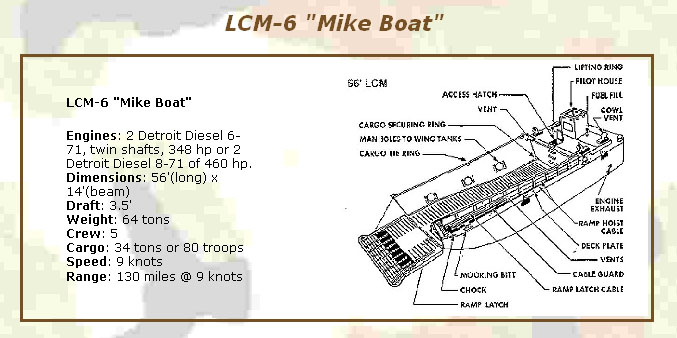
Much of my duty consisted of driving a 56' Mike-boat (LCM) between the base, (where I bunked) and NavOrdFac on Azuma Island (where I worked). When I wasn't driving the Mike boat, I was hauling mines between the shops where they were inspected and re-painted, back to the reventment bunkers where they were stored. I was also in charge of the tool room and paint locker for mine assembly and maintenance on Azuma Island. Our chief was MNC Bill Poole.
Each noon, I took the boat to the base to pick up the Japanese mess crew. They worked out of the main mess hall at FleetActivitiesYokosuka (FAY) and were responsible for providing our meals. The Japanese Mess Sergeant in charge became a close personal friend and I was privileged to meet his family and friends. We all called him 'Skivvy.' I made Mineman 2nd Class (MN2) but activities during liberty resulted in that second stripe being removed. Sighhhh!
In October, 1959, I was honorably discharged after four years of naval service. At age 21, I found myself in the socio-dynamic city of San Francisco, I enjoyed my newly attained military freedom and civilian life. 2005 marked the 50th anniversary of my enlistment. My, how time flies.
EPILOGUE
I've been aboard several of the old "clamshell" LSTs and was amazed at how much they could carry. The Newport class of LSTs were designed after I left the navy. When I first saw them I was fascinated with the smooth lines and the bow ramp system. When I saw the film of the "Skinny-T" being mercilously blasted out of the water during Operation Resultant Fury, I felt a need to provide a forum for the officers and crew who honorably served this fleet workhorse. The creation of the web site has been a work of love for me. I was extremely fortunate to meet a former crew member, Tom Totoris ("Toto") who was willing to take over the web site and become its webmaster. Please help him and provide your comments, stories and pictures.
Thanks a lot, Buddy.
Derick S. Hartshorn
(Creator of the Skinny-T web site)
You are visitor

to the Skinny-T
since April 1, 2005
Tom Totoris-Webmaster ©2006
Last Modified: